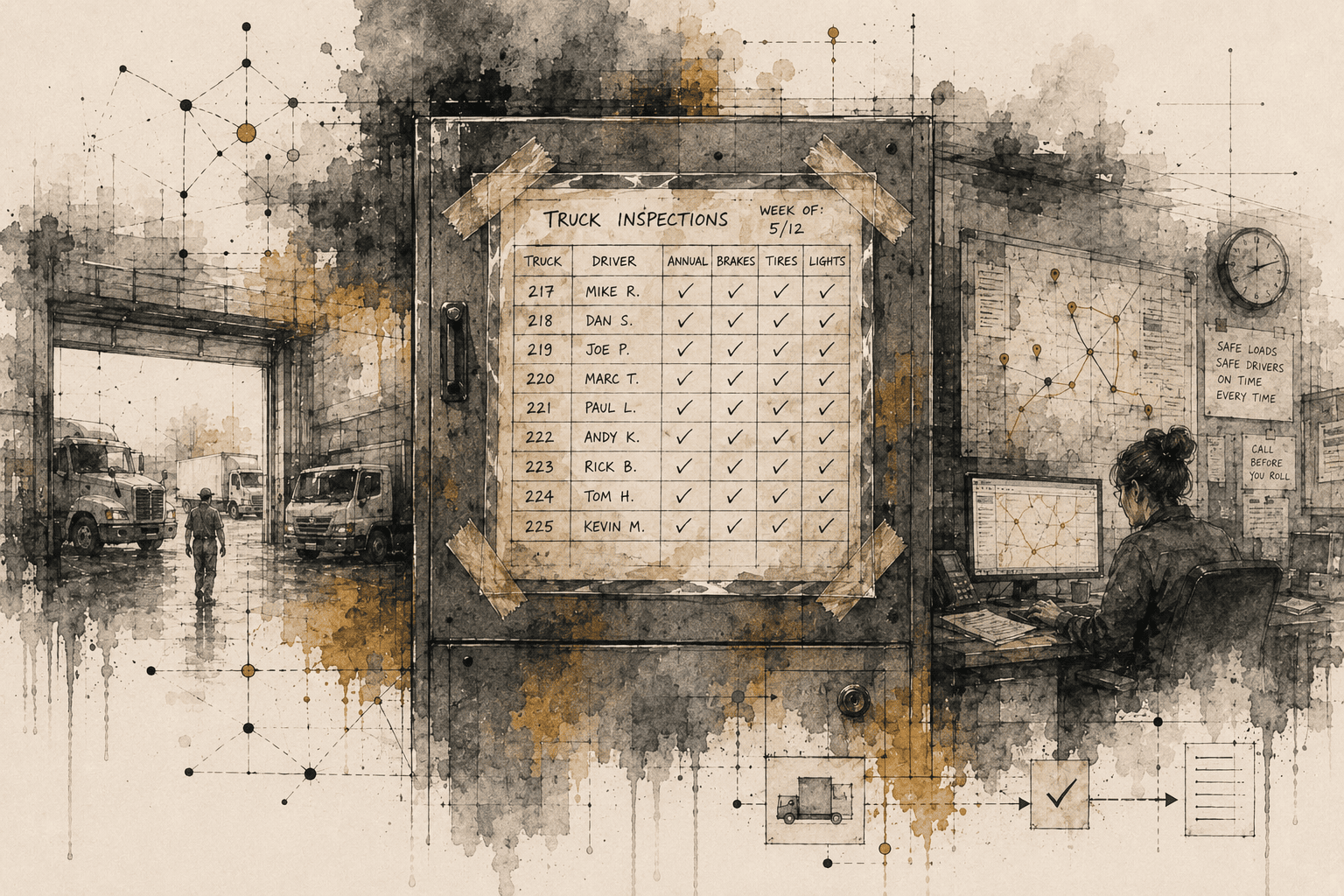
Walk into enough dispatch offices and eventually you'll find a card like this one: laminated, taped inside a cabinet, hand-written truck numbers, hand-written driver names, a grid of checkmarks nobody officially asked for. Somebody built it because the routing software could tell her which truck was assigned to which job, but it couldn't tell her which trucks had passed their annual inspection that week. So she made her own tracker, laminated it against the shop grease and coffee, and taped it where she could see it every morning.
Nobody laminates a piece of paper they expect to throw away next week. Lamination is what you do to something you've decided you'll need for a long time, something worth protecting the way the company protects its real records. This one never became one. It does load-bearing work every morning and appears in no system, no report, no meeting.
The easy read is wrong
The easy read on that card is compliance. Someone went outside the system. Get her onto the software properly, retrain her, done.
That read is wrong, and it's wrong in a way that costs money every time it's made. The card is evidence that the official system has a hole in it, in a specific place, and that someone has been quietly covering that hole out of her own pocket ever since.
What the tape is telling you
A hand-built tracker taped to a cabinet is duct tape. Duct tape shows up wherever a part keeps failing and nobody has replaced it properly yet. A mechanic who finds tape holding a hose in place doesn't confiscate the tape and write the operator up for improvising. The tape tells him exactly which part failed and where. It names the problem in a shape precise enough to fix.
The card does the same thing. It names the exact gap. The routing software tracked assignment. It didn't track inspection status. Someone needed both to make a safe call every morning, and the wait for someone else to fix that was longer than the cost of fixing it herself. Every morning that card stayed on the cabinet, the real system was quietly failing a specific, nameable test, and an operator was covering for it without being asked and without getting credit.
Why it stays invisible
Founder-led companies feel this hard, because there's usually no ops layer between the founder and the floor to notice the card is even there. The founder sees the routing software working. The dispatcher sees the routing software working and a laminated card doing the rest of the job. Both are right, which is exactly the problem. Nobody is lying to anybody. The report the founder gets and the reality the dispatcher manages have quietly split into two separate systems, and only one of them shows up when someone asks how the business runs.
The split hides itself. The card lives in a cabinet, not a database. It never generates a number that lands in a report. The only person who knows the routing system has a hole is the person who's been patching it, and she's stopped mentioning it, because she solved it eighteen months ago and moved on.
The move that makes it worse
The fast reaction is to treat the shadow process as the defect and design the fix around eliminating it. Sometimes that's a new policy telling people to stop making their own trackers. Sometimes it's new software meant to make the workaround unnecessary. Either way, the fix targets the tape instead of the hole. The tape comes off. The hole stays open.
It resurfaces somewhere else, usually somewhere less visible, because the person who built the first tracker has now learned that building one gets it taken away. The next one gets built quietly. A crew stops keeping the paper tally after new inventory software goes live, then starts a group chat where they photograph the shelves the software still can't see. Same hole, same unpaid hours covering for it, now moved off the cabinet wall and out of anyone's line of sight.
The move that fixes it
The right move starts with the question the tape is answering, not the tape itself. What is this actually holding together. What condition happens often enough, and matters enough, that someone spent their own time solving it without being asked. Answer that specifically enough to fix the actual joint, and the workaround stops being necessary on its own. Nobody has to be told to stop using it. There's nothing left for it to hold.
This is the part that gets skipped, and it's the part that separates reading an operation from lecturing one. A dispatcher who built a tracker to catch an inspection gap is the best source in the building on where the routing system stops matching how the operation actually runs. Every taped-up card, every side spreadsheet, every whiteboard column that never makes it into an official report is the same kind of evidence. It's specific. It's field-tested. It cost the company nothing to produce, because someone already built it for free, out of necessity, and left it exactly where it could be found.
Reading it takes longer than removing it. That's the whole reason most operations remove it first. But a hole that gets patched over without being mapped doesn't stay closed. It waits for the next person who runs into it, and costs that person the same unpaid hours the last one put in, solving a problem the company already had, taped to a cabinet, in plain sight, the whole time.